Wood-Pressed vs. Cold-Pressed Oil: What is the Difference?
Wood-Pressed vs. Cold-Pressed Oil: Why "Cold" Isn't Good Enough
If you walk down the health food aisle today, you will see dozens of bottles labeled "Cold-Pressed." They claim to be healthy, natural, and raw.
But here is the truth that most big brands won't tell you: "Cold-Pressed" is an industrial standard, not a traditional one.
At Roots and Richness, we often get asked: "Is your oil cold-pressed?" Our answer is simple: "No. It is better. It is Wood-Pressed."
There is a critical difference between these two methods, and your family's health depends on knowing it. In this guide, we break down the Wood-Pressed vs. Cold-Pressed oil difference to help you choose the healthiest option for your kitchen.
The Machine Makes the Difference: Steel vs. Wood
The term "Cold-Pressed" usually refers to the temperature of the oil, not the machine used. As long as the oil doesn't exceed a certain temperature (usually 49°C - 60°C) during extraction, a factory can legally label it "Cold-Pressed."
But how they get the oil out matters.
1. Standard Cold-Pressed (The Steel Press)
Most commercial "Cold-Pressed" oils are made using a Rotary Steel Expeller.
- The Material: Metal (Steel/Iron).
- The Process: The seeds are crushed between steel gears rotating at high speeds (High RPM).
- The Hidden Problem: Steel rubbing against steel generates friction heat. Even though they don't add external fire, the internal temperature of the oil often rises to 60°C.
- The Result: The oil is "cooked" slightly. It loses some delicate antioxidants and its raw, fresh aroma.
2. Wood-Pressed (The Mara Chekku / Ghani)
This is the traditional method used for thousands of years in India, and it is the only method we use at Roots and Richness.
- The Material: Vagai Wood (Traditional Stone or Wood Mortar).
- The Process: A heavy wooden pestle rotates inside a wooden mortar at very slow speeds (Low RPM).
- The Advantage: Wood acts as a heat insulator. It does not conduct heat like steel. No matter how long we press, the oil remains strictly at room temperature (below 30°C).
- The Result: The oil is biologically "alive." It retains 100% of its nutrients, natural flavor, and density.
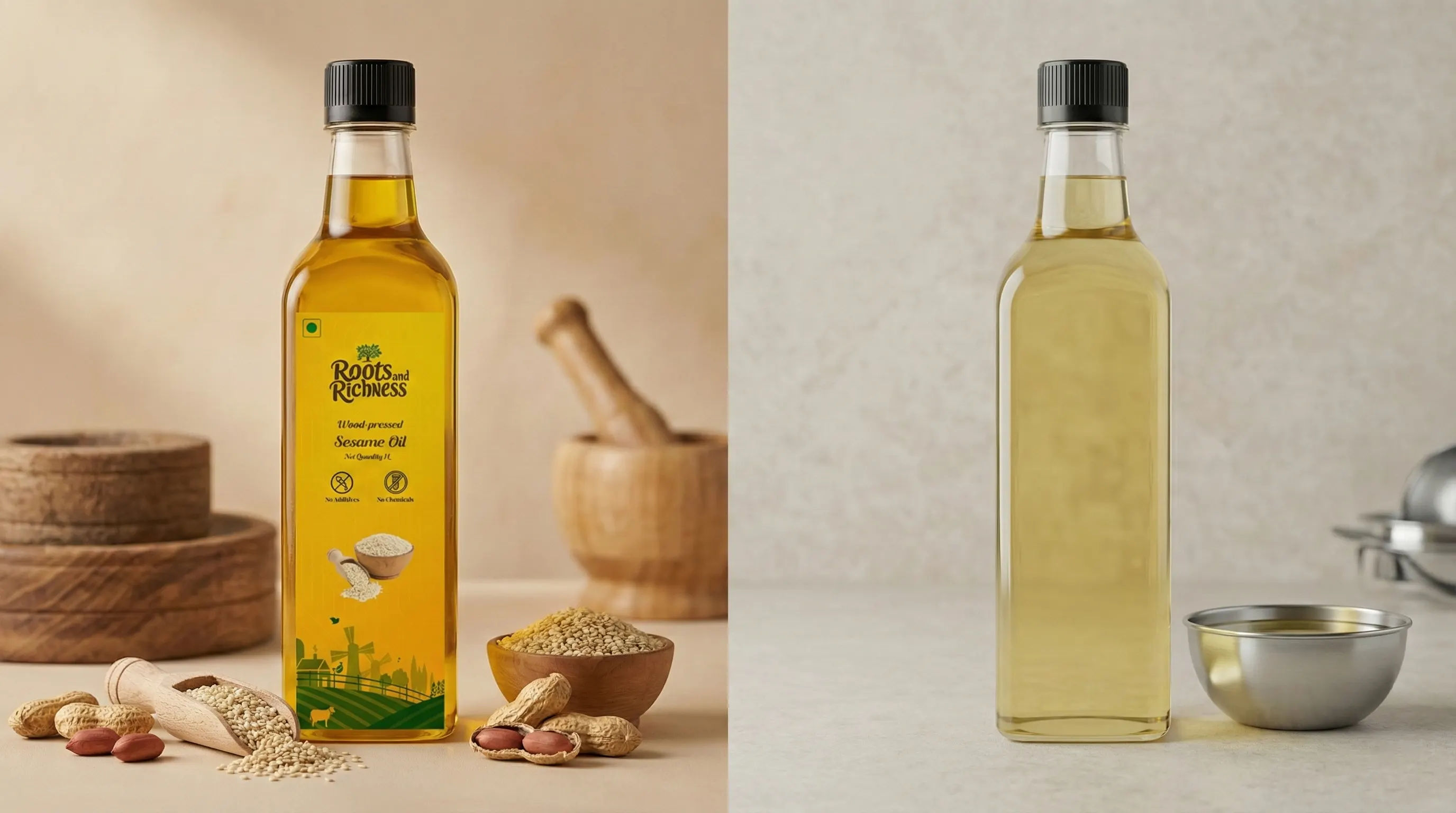
Pro Tip: If you are looking for true flavor for your pickles, check out our [Wood Pressed Sesame Oil] which uses this exact method.
The Showdown: Wood-Pressed vs. Standard Cold-Pressed
Here is the definitive comparison of Wood Pressed Oil (Mara Chekku) vs. Industrial Cold Pressed Oil to help you understand the difference in quality.
1. Heat Generation
- Standard Cold-Pressed (Steel): The high-speed rotation of steel gears creates friction. This friction generates internal heat (often up to 60°C), which begins to cook the oil inside the machine.
- Wood-Pressed (Mara Chekku): Winner. The wooden pestle moves slowly, and wood does not conduct heat. The oil remains strictly at room temperature (below 30°C) throughout the entire process.
2. Nutrient Retention
- Standard Cold-Pressed (Steel): Due to the friction heat, you lose a percentage of heat-sensitive antioxidants and Vitamin E.
- Wood-Pressed (Mara Chekku): Winner. Because there is zero heat shock, you get 100% retention of nutrients. It is the closest you can get to eating the raw seed itself.
3. Aroma & Flavor
- Standard Cold-Pressed (Steel): The flavor is often mild, flat, or bland because the volatile aroma compounds evaporate when the machine heats up.
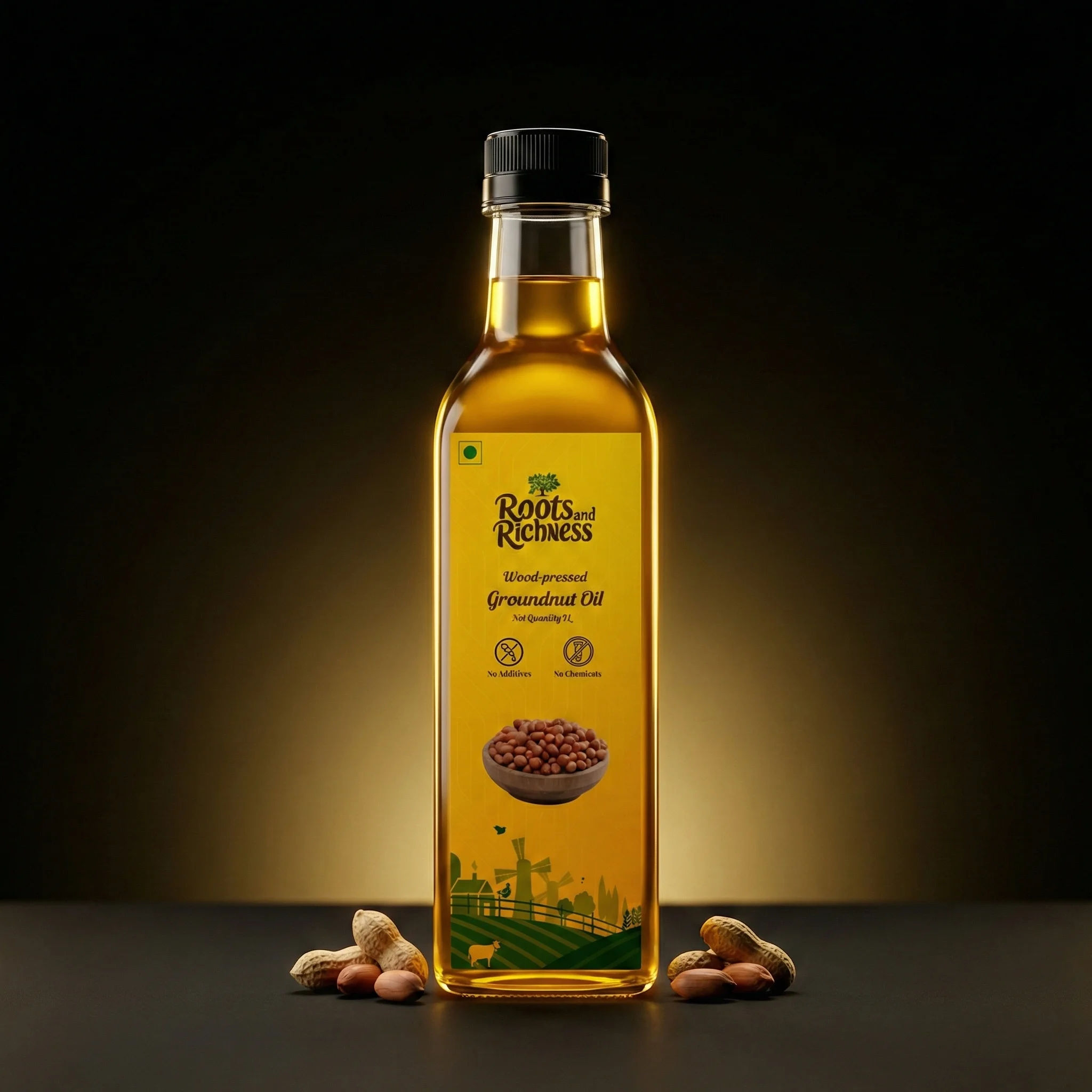
- Wood-Pressed (Mara Chekku): Winner. The oil is rich, nutty, and distinct. Our Groundnut Oil smells like fresh roasted peanuts, and the texture is noticeably thicker and more viscous.
4. Purity & Filtration
- Standard Cold-Pressed (Steel): Usually machine-filtered to look "clean" and shiny, stripping away healthy fibers.
- Wood-Pressed (Mara Chekku): Winner. We use natural sedimentation. We let the oil sit so the heavy sediments settle naturally. This leaves the fine, healthy fruit fibers in the oil (which is why you might see a cloudy bottom—that is the good stuff!).
Why Wood-Pressed Tastes Different
Have you ever bought a "Cold-Pressed" Groundnut oil that tasted... bland? That is because the delicate flavor compounds were destroyed during the high-speed pressing.
Wood-Pressed Oil is different. Because it never heats up, it is thicker, richer, and more potent. You actually need to use less of it while cooking because the flavor is so strong.
Did You Know? True Wood-Pressed oil will often have a small amount of sediment at the bottom of the bottle. This is not dirt! It is a sign of purity. It means the oil was not machine-filtered but naturally settled, keeping the healthy fruit fibers intact.
The Verdict: Upgrade Your Kitchen
"Cold-Pressed" was a great step away from refined chemicals. But Wood-Pressed is the return to perfection.
If you are going to pay a premium price for health, ensure you are getting the real thing. Don't settle for industrial imitations. Look for the Wooden Ghani method.
Ready to taste the difference?
- [Shop Wood-Pressed Groundnut Oil] – The King of Indian Cooking.
- [Shop Wood-Pressed Sesame Oil] – For pickles, skin, and flavor.
- [Shop Wood-Pressed Coconut Oil] – Pure, raw, and aromatic.
Frequently Asked Questions (FAQs)
1. Is Wood Pressed oil the same as Cold Pressed? No. While all wood-pressed oils are cold-pressed (low temperature), not all cold-pressed oils are wood-pressed. Most cold-pressed oils are made in steel machines that generate heat, whereas wood-pressed oils (Mara Chekku) use a wooden pestle to ensure zero heat generation.
2. Can I use Wood Pressed Groundnut Oil for deep frying? Yes! Wood Pressed Groundnut oil has a high smoke point (approx 230°C), making it excellent for deep frying. Unlike refined oils, it does not break down into toxic compounds easily.
3. Why is Wood Pressed oil more expensive? The yield of oil in the wood-pressing method is lower because no chemicals or heat are used to extract every last drop. However, the quality, density, and nutrient value are significantly higher.
Featured Products Mentioned in This Article
Experience the premium wood-pressed oils we discussed in this article. Each product is traditionally processed and sourced directly from farmers.