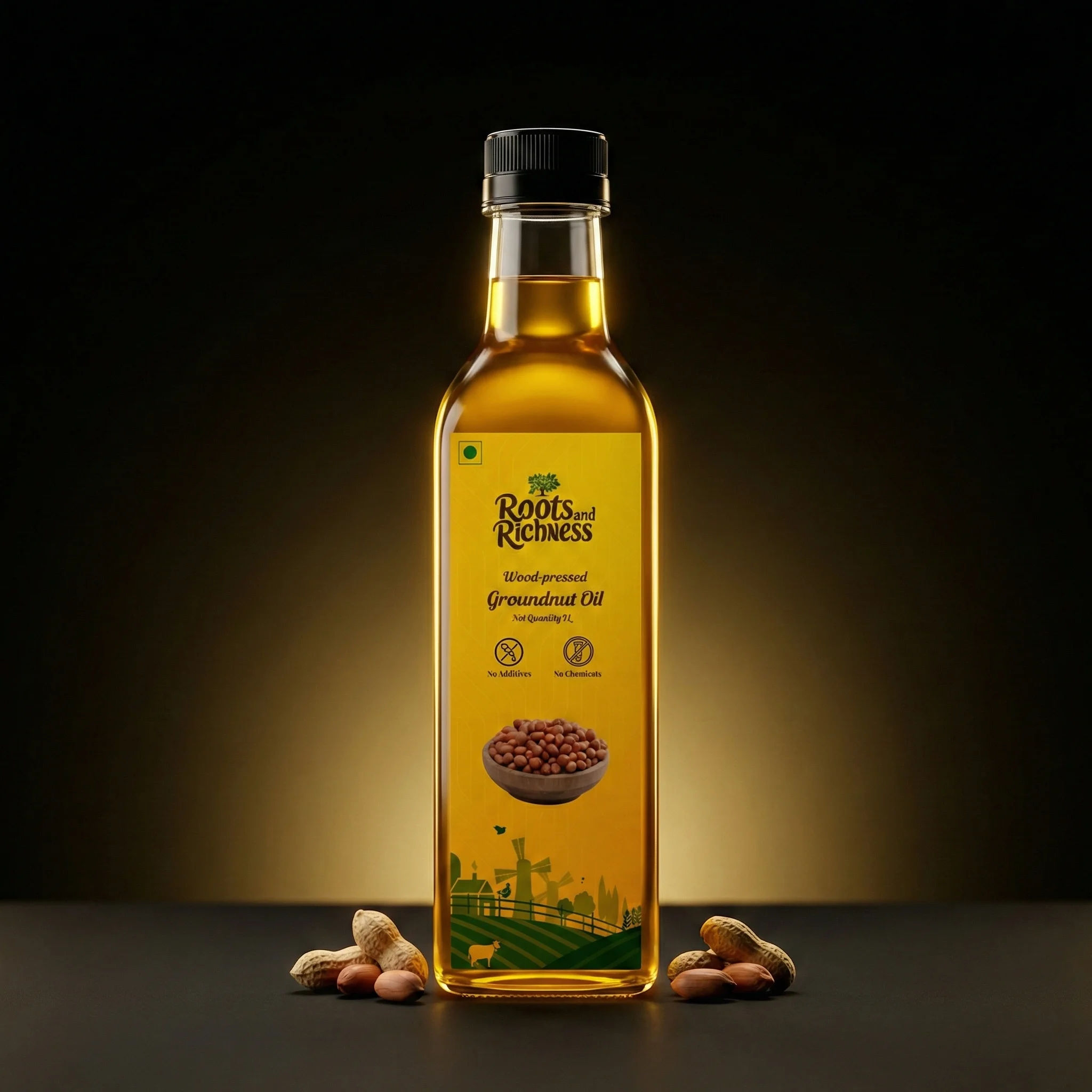
Wood-Pressed vs. Cold-Pressed vs. Refined Oil: Which is Actually Healthiest?
Confused by oil labels? We break down the difference between wood-pressed, cold-pressed, and refined oils. Discover why traditional Mara Chekku oil is the healthiest choice for your family.
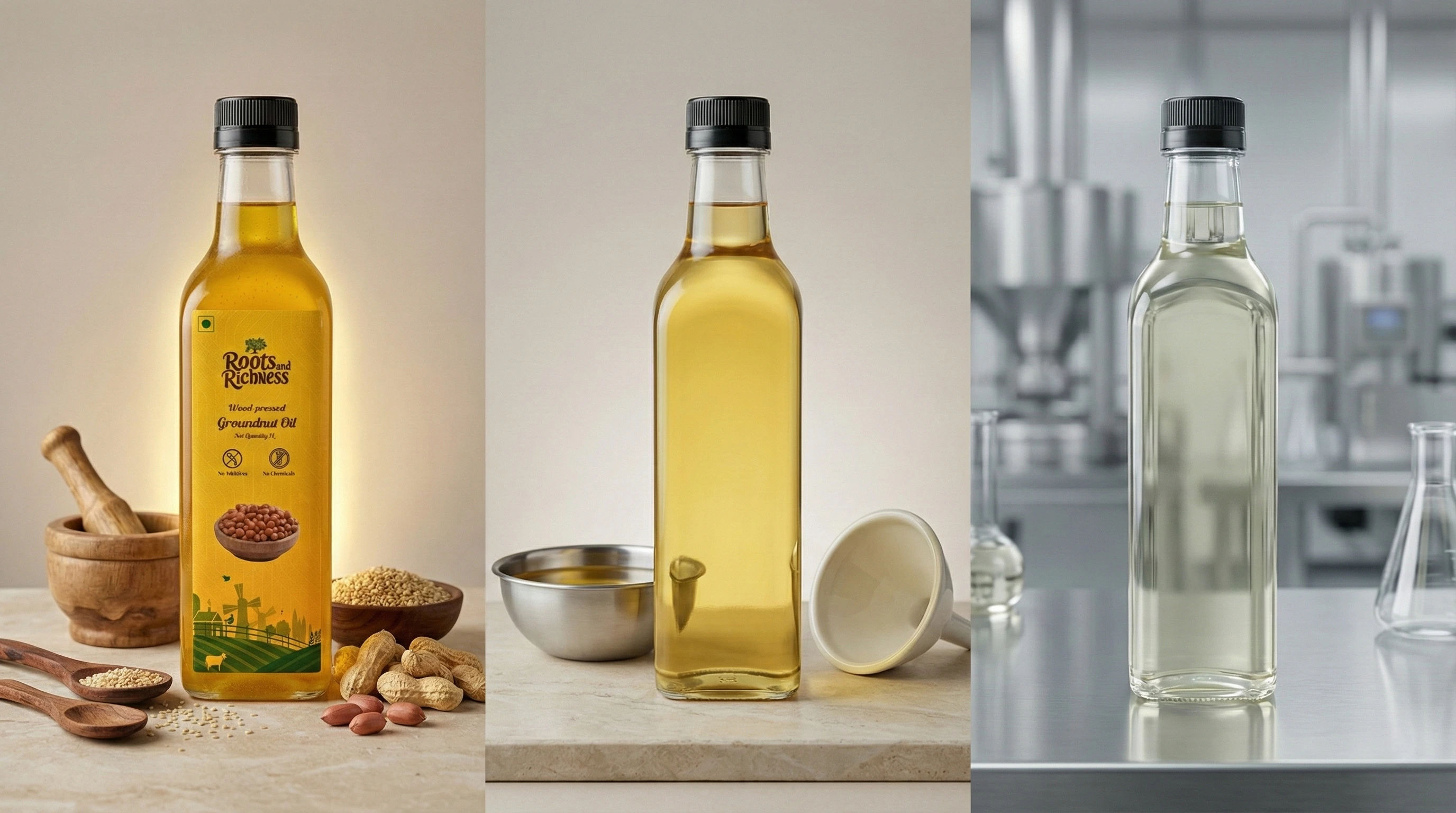
Refined vs. Cold-Pressed vs. Wood-Pressed: The Ultimate Guide to Healthy Oils
Walk into any Indian supermarket today, and the cooking oil aisle is a confusing place. You see labels shouting "Refined," "Double Filtered," "Cold-Pressed," and "Wood-Pressed."
If you care about your family’s heart health, you’ve likely stood there asking: What is the actual difference? Is "Cold-Pressed" the same as the traditional "Wood-Pressed" oils our grandmothers used in the village?
The short answer is No.
There is a massive difference in how these oils are made, how they taste, and how they affect your body. In this comprehensive guide, we break down the science behind Wood-Pressed vs. Cold-Pressed vs. Refined Oil to help you make the only choice that matters for your health.
The 3 Ways Oil is Made: A Simple Breakdown
To understand which is healthiest, we must look at the extraction method. The "purity" of oil is determined by one thing: Heat.
1. Refined Oils (The Chemical Method)
This is the standard transparent oil found in 90% of kitchens. To get every last drop out of the seed, manufacturers use:
- High Heat: Seeds are heated to over 200°C.
- Chemical Solvents: A petroleum byproduct called Hexane is used to extract the oil.
- Bleaching & Deodorizing: Because the high heat ruins the taste and color, the oil is bleached and chemically deodorized to look "clean."
- The Result: A nutrient-dead liquid that has lost its natural bonds, often containing traces of trans fats.
2. Cold-Pressed Oils (The Industrial Method)
"Cold-pressed" is a healthier step up. It generally refers to oils extracted using a Rotary Steel Press.
- No Chemicals: It is purely mechanical.
- The Hidden Issue: While no external heat is applied, the friction of steel-on-steel rotating at high speeds (High RPM) can generate internal temperatures rising to 50°C - 60°C.
- The Result: A good oil, but some heat-sensitive nutrients (like delicate antioxidants) are lost during the friction process.
3. Wood-Pressed / Mara Chekku Oils (The Traditional Method)
This is the Roots and Richness standard. Also known as Mara Chekku (Tamil) or Kachi Ghani (Hindi).
- The Mechanism: We use a traditional Wooden Pestle (Ghani) made from Vagai wood.
- The Speed: It rotates extremely slowly (Low RPM).
- The Temperature: Because wood does not conduct heat like steel, the oil remains strictly at room temperature (below 30°C).
- The Result: Oil that is "alive." It retains 100% of its Vitamin E, micronutrients, and authentic aroma.
Did You Know? It takes roughly 2.5kg to 3kg of raw groundnut seeds to make just one litre of our Wood-Pressed Groundnut Oil. Refined oil manufacturers can make much more oil from the same amount of seeds using chemicals. This is why refined oil is cheap—you are paying for volume, not quality.
Inside the Press: How We Make It at Roots and Richness
(The Experience & Authenticity)
When we say "Traditional," we don't just mean the label. At our facility, the air smells thick with the aroma of roasting nuts. We source our Groundnuts and Sesame seeds directly from farmers in the rich soils of Andhra Pradesh, ensuring only the sun-dried, premium grade seeds make the cut.
When we run our wooden Ghani:
- It is Slow: A batch that takes an industrial machine 20 minutes takes us hours. We don't rush nature.
- It is Cool: You can touch the oil flowing out of the press with your bare hand—it feels cool, just like the room air.
- It is Unfiltered: We don't machine-filter our oils. We let them undergo Natural Sedimentation for 3-4 days. This allows the heavy sediments to settle at the bottom naturally while keeping the microscopic fruit fibers in the oil.
This is why our oil might look slightly "cloudy" compared to water-clear refined oils. That cloudiness is nutrition.
3 Myths About Wood-Pressed Oils (Busted)
There is a lot of misinformation online. Let's clear it up.
Myth #1: "You cannot deep fry in Wood-Pressed Oil."
- Fact: You absolutely can. In fact, Indian cuisine has used Wood-Pressed Groundnut Oil and Sesame Oil for deep frying for centuries before refined oil existed. Wood-pressed groundnut oil is rich in monounsaturated fats, making it highly stable at high heat. It adds a delicious flavor to pooris and bajjis that refined oil simply cannot match.
Myth #2: "It expires too quickly."
- Fact: Pure oil has a natural shelf life of 6 months. While we don't add artificial preservatives (like TBHQ found in refined oils), wood-pressed oils are naturally high in Vitamin E, which acts as a preservative. If you keep moisture away, your oil stays fresh and aromatic for months.
Myth #3: "All 'Cold Pressed' oils are Wood Pressed."
- Fact: No. Most commercial brands use "Cold Pressed" as a marketing term for steel expeller pressing. Unless the label specifically says "Wood Pressed" or "Mara Chekku", it was likely made in a steel machine. Always look for the word "Wood" or "Ghani."
The Health Verdict: Why Switch?
1. Heart Health & Cholesterol Refined oils are inflammatory. Wood-pressed oils, specifically Groundnut and Sesame, are rich in MUFA (Monounsaturated Fatty Acids). According to heart health studies, MUFA helps lower "Bad" LDL cholesterol while maintaining "Good" HDL cholesterol.
2. Insulin Sensitivity Traditionally, Wood-Pressed Sesame Oil has been linked to regulating blood sugar levels. The presence of lignan, a natural compound found in sesame, acts as a powerful antioxidant that is often stripped away during refining.
3. Digestion & Gut Health Ayurveda suggests that lubrication is essential for gut health. The natural viscosity of wood-pressed oils helps in better absorption of food and smoother digestion. This is why a teaspoon of pure ghee or wood-pressed oil is often added to hot rice.
How to Identify Pure Wood-Pressed Oil at Home
(The Sensory Test)
Don't just trust the label. Trust your senses.
- The Aroma Test: Open the bottle. Close your eyes and inhale.
- Groundnut Oil: Should smell strongly of fresh peanuts.
- Sesame Oil: Should have a distinct, earthy, slightly pungent smell.
- Coconut Oil: Should smell like fresh roasted copra.
- If it smells like nothing (or like plastic), it is refined.
- The Viscosity Test: Pour a drop on your palm. It should feel thick and sticky, not watery.
- The Taste Test: Taste a raw drop. It should taste strictly of the seed. You should not feel a "greasy" coating on your tongue that refuses to go away.
Conclusion: Return to Your Roots
We live in a world of quick fixes and processed foods. But when it comes to the oil that forms the base of every single meal you cook—from your morning dosa to your dinner dal—shortcuts aren't worth it.
Switching to Roots and Richness Wood-Pressed Oil isn't just a purchase; it's an investment in your family's long-term health. It’s a return to the wisdom of our ancestors.
Ready to make the switch?
- [Shop Wood-Pressed Groundnut Oil] – The King of Indian Cooking.
- [Shop Wood-Pressed Sesame Oil] – For pickles, skin, and flavor.
- [Shop Wood-Pressed Coconut Oil] – Pure, raw, and aromatic.
- [Shop Wood-Pressed Castor Oil] – For hair growth and wellness.
Experience the richness of tradition with every drop.
Frequently Asked Questions
What is the difference between wood pressed and cold pressed oil?
The main difference is heat. Wood pressed oil (Mara Chekku) is extracted using a wooden pestle at very low speeds, keeping the temperature below 30°C to retain 100% of nutrients. Standard cold pressed oils often use steel presses that generate friction heat up to 60°C.
Is wood pressed oil better for Indian cooking?
Yes. Wood pressed oils like Groundnut and Sesame are heat-stable and perfect for deep frying and tadkas. Unlike refined oils, they retain their natural nutrients and 'good fats' even during cooking.
Does wood pressed oil have a strong smell?
It has a natural, mild aroma of the seed (like fresh peanuts or sesame). It is not overpowering, but it is much richer than refined oils, which are chemically deodorized and odorless.
Featured Products Mentioned in This Article
Experience the premium wood-pressed oils we discussed in this article. Each product is traditionally processed and sourced directly from farmers.