7 Benefits of Switching to Chicory-Free Coffee (And Is It Worth the Price?)
Quick Answer
Is chicory-free coffee actually worth the higher price? Here are 7 real benefits of switching — plus how to tell if a "chicory-free" claim is genuine or just marketing.
Key Takeaways
- Chicory has zero caffeine, so a chicory-blended tin delivers less actual caffeine per spoon than a pure coffee tin.
- The flat, earthy aftertaste in most instant coffee usually comes from chicory, not the coffee bean.
- Chicory-free coffee is worth a premium only when the ingredient list is genuinely verifiable — 'coffee' and nothing else.
- Chicory-free coffee carries no extra safety consideration versus any other coffee at normal daily intake.
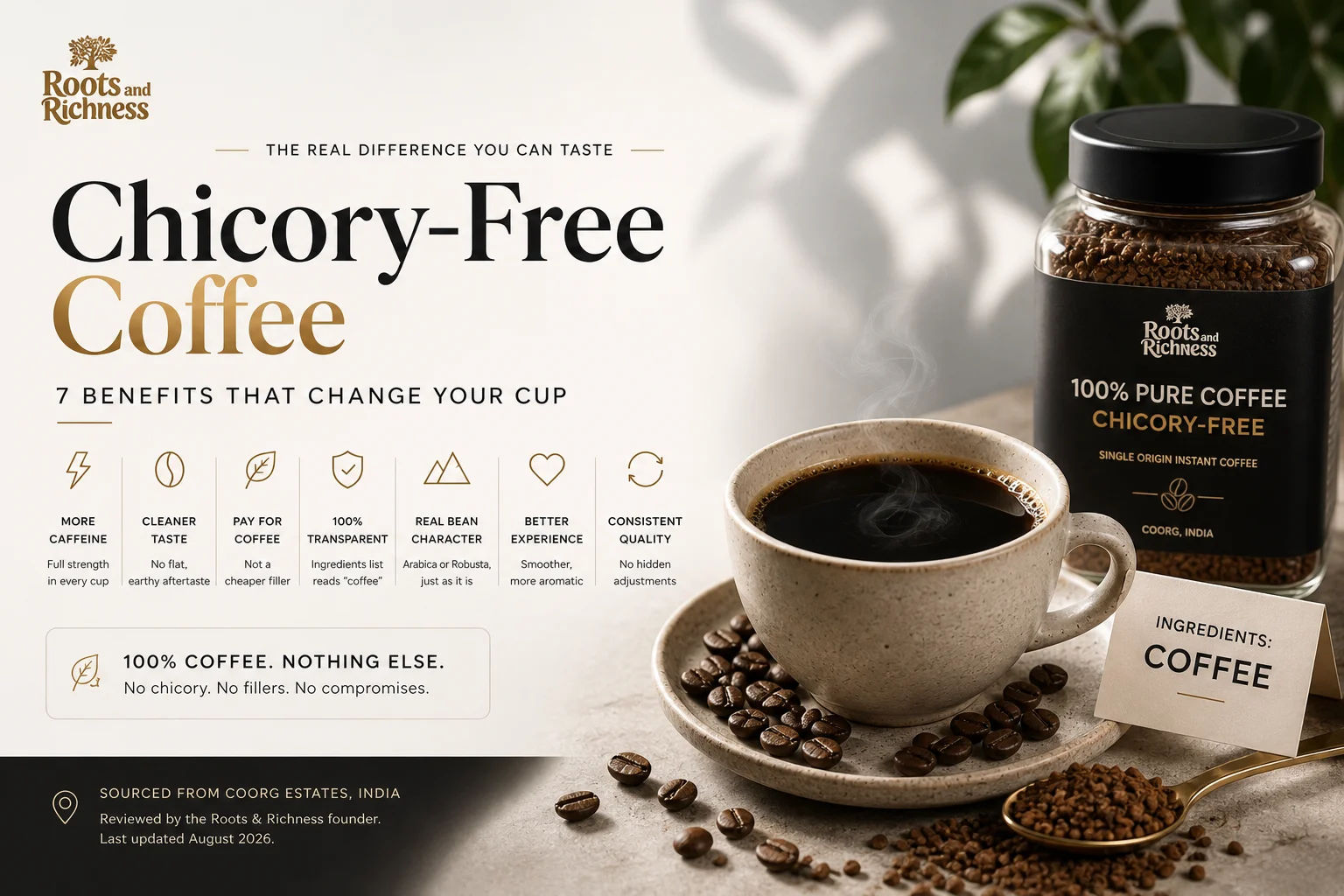
Chicory-Free vs. Chicory-Blended, At a Glance
| Attribute | Chicory-Blended | Chicory-Free (100% Pure) |
|---|---|---|
| Caffeine per serving | Lower — diluted by filler | Full-strength |
| Aftertaste | Flat, earthy, more bitter | Cleaner, more aromatic |
| What you're paying for | Coffee + cost-cutting filler | Coffee only |
| Ingredient transparency | Requires reading fine print | Ingredient list reads "coffee" |
Reviewed by the Roots & Richness founder, who sources the AM/PM Protocol directly from Coorg coffee estates. Last updated August 2026.
Quick Answers
What actually changes when you switch to chicory-free coffee? Switching to chicory-free coffee increases the actual caffeine per cup, removes the flat and earthy aftertaste chicory adds, and means the full price you pay is going toward coffee — not a cheaper filler root.
Is chicory-free coffee worth the higher price? Chicory-free coffee is worth the price when it's verifiably 100% coffee, since you're paying for more actual coffee and more caffeine per serving than a chicory-blended tin at a similar price point — not paying more for the same thing.
Does chicory-free coffee taste stronger? Chicory-free coffee tends to taste smoother and more aromatic rather than harshly "stronger" — much of the bitterness people associate with strong coffee actually comes from chicory, not the coffee bean itself.
Is it safe to drink chicory-free coffee every day? Yes. 100% pure coffee is safe for daily consumption for most healthy adults in normal amounts (roughly 3–4 cups/400mg caffeine a day per general dietary guidance) — the same guidance that applies to any coffee, chicory-blended or not.
Will chicory-free coffee dissolve the same way as a chicory blend? Yes, if it uses the same instant coffee process (agglomerated or spray-dried) — chicory-free simply means the ingredient list has no chicory, not a different preparation method.
Chicory-Free vs. Chicory-Blended — At a Glance
| Chicory-Blended Instant Coffee | Chicory-Free (100% Pure) Coffee | |
|---|---|---|
| Caffeine per serving | Lower — diluted by non-caffeine filler | Full-strength |
| Aftertaste | Flat, earthy, more bitter | Cleaner, more aromatic |
| What you're paying for | Coffee + a cost-cutting root filler | Coffee only |
| Ingredient transparency | Requires reading the fine print | Ingredient list reads "coffee" |
What Makes Chicory-Free Coffee Different
Most Indian instant coffee brands blend in chicory — a roasted, caffeine-free root — to stretch fewer coffee beans across more tins without raising the shelf price. It's legal, declared on the label, and completely normalized in the category. It's also the reason a lot of instant coffee tastes flatter and more bitter than it needs to, and delivers less actual caffeine than the tin size suggests.
Chicory-free coffee removes that substitution entirely. Unlike blended tins, a genuinely chicory-free product has an ingredients list that reads only "coffee" — nothing added for bulk, nothing to dilute the caffeine, nothing masking the bean's actual flavor.
7 Benefits of Switching to Chicory-Free Coffee
1. More Caffeine Per Cup
Since chicory has zero caffeine, every gram of a chicory-blended tin that isn't coffee is a gram doing nothing for your alertness. A chicory-free tin delivers full-strength caffeine per spoon, with nothing diluting it.
2. A Cleaner, Less Bitter Aftertaste
The earthy, woody edge most people associate with "strong" instant coffee usually comes from chicory's roasting profile, not the coffee bean. Removing it tends to reveal a smoother, more aromatic cup than expected.
3. You're Paying for Coffee, Not a Filler
A chicory-blended tin and a chicory-free tin can be priced almost identically — but one of them is putting a meaningful percentage of that price toward a cheap root extender instead of coffee.
4. Bean Character Actually Comes Through
With no filler masking the flavor, the real differences between beans — like Arabica's smoothness versus Robusta's boldness — become noticeable in a way they aren't in a chicory blend, which is part of why pairing the right bean to the right time of day only really matters once chicory is out of the picture.
5. Full Ingredient Transparency
A chicory-free product's ingredients list is about as simple as a label gets: "coffee." There's no need to check quantities, percentages, or additive names — there's nothing else to check.
6. No Guessing Games With Instant Coffee's Reputation
Instant coffee gets a reputation for being a lesser category partly because chicory-diluted versions taste flatter than they should. A well-made, chicory-free, properly-processed instant coffee doesn't carry that same disadvantage.
7. Consistency You Can Actually Trust
A "coffee, chicory" blend can shift its ratio between batches without the product name or price changing. A single-ingredient product has nothing to quietly adjust — what's in the tin today is what was in it last time.
Is It Actually Safe to Drink Every Day?
Yes, in the same way any coffee is safe for daily use. General dietary guidance for healthy adults suggests up to roughly 400mg of caffeine a day — about 3–4 cups of coffee — is not associated with adverse effects for most people. Chicory-free coffee doesn't introduce any new safety consideration; if anything, it removes chicory as a variable, which is itself a well-established, generally recognized-safe food ingredient with no specific daily limit of its own for most healthy adults. As always, anyone pregnant, caffeine-sensitive, or managing a health condition should follow their own doctor's specific guidance rather than general guidelines.
Is the Price Actually Worth It?
The honest answer: it depends entirely on whether the "chicory-free" or "single-origin" claim is verifiable. If a brand won't say which estate or region the coffee came from, or its ingredient list still shows chicory in smaller print, you're not actually getting what the price implies. If the ingredients list genuinely reads "coffee" and nothing else, you're paying for more actual coffee and more caffeine per serving than a similarly-priced blended tin — which is a real, checkable trade, not a marketing story.
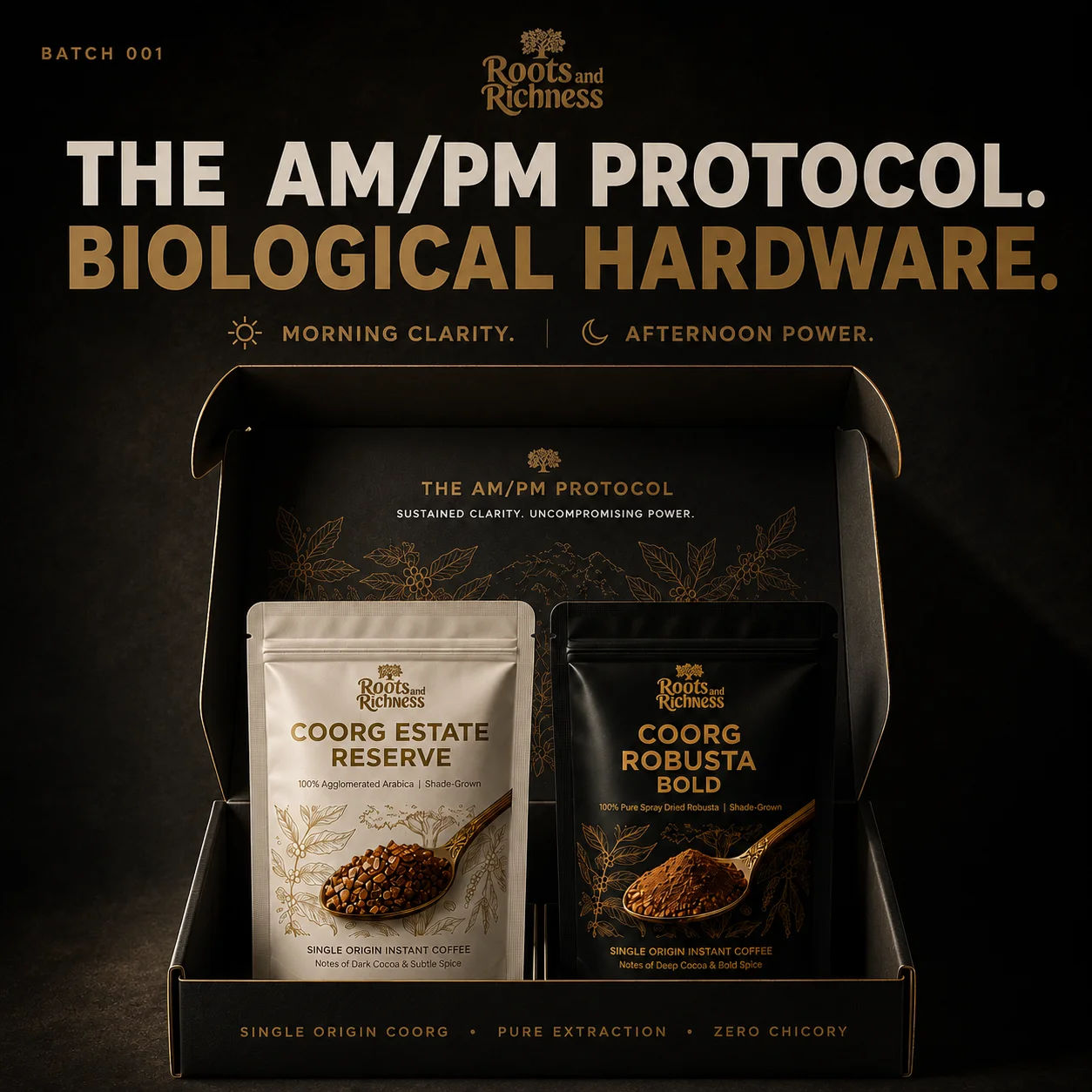
The AM/PM Protocol is built to pass that check directly: two 100g pouches, single-origin Coorg Arabica for the morning and single-origin Coorg Robusta for the afternoon, both listing coffee as the only ingredient. At ₹799 for 50 cups, that's ₹16 a cup for coffee with nothing to dilute it — verifiable on the label, not just claimed on the packaging.
93 of 100 units in this batch are already gone. It's roasted and packed in small batches out of Coorg, so once this run sells out, the next isn't ready for 3–4 weeks.
Frequently Asked Questions
What actually changes when you switch to chicory-free coffee? Switching increases the actual caffeine per cup, removes the flat, earthy aftertaste chicory adds, and means the full price you pay goes toward coffee rather than a cheaper filler root.
Is chicory-free coffee worth the higher price? It's worth it when the claim is verifiable — check that the ingredients list genuinely reads "coffee" only, since that's what you're paying the premium for.
Is it safe to drink chicory-free coffee every day? Yes, for most healthy adults in normal amounts, following the same general caffeine guidance (roughly 3–4 cups/400mg a day) that applies to any coffee.
Is the AM/PM Protocol genuinely chicory-free? Yes. Both the Arabica (AM) and Robusta (PM) pouches list coffee as the only ingredient, sourced from Coorg estates with no chicory, fillers, or anti-caking agents.
Ready to check the label for yourself? Get the AM/PM Protocol — ₹799 for 50 cups · Free shipping · 7-day refund guarantee · 7 units left in this batch
Did You Know?
A "coffee, chicory" blend can quietly shift its ratio between production batches without the product name or price ever changing.
Did You Know?
General dietary guidance places safe daily caffeine intake for healthy adults at roughly 400mg — about 3-4 cups — the same guidance for any coffee, chicory-blended or not.
Still Deciding?
Which Coffee Is Right for You?
Morning Person
AM · 100% Arabica
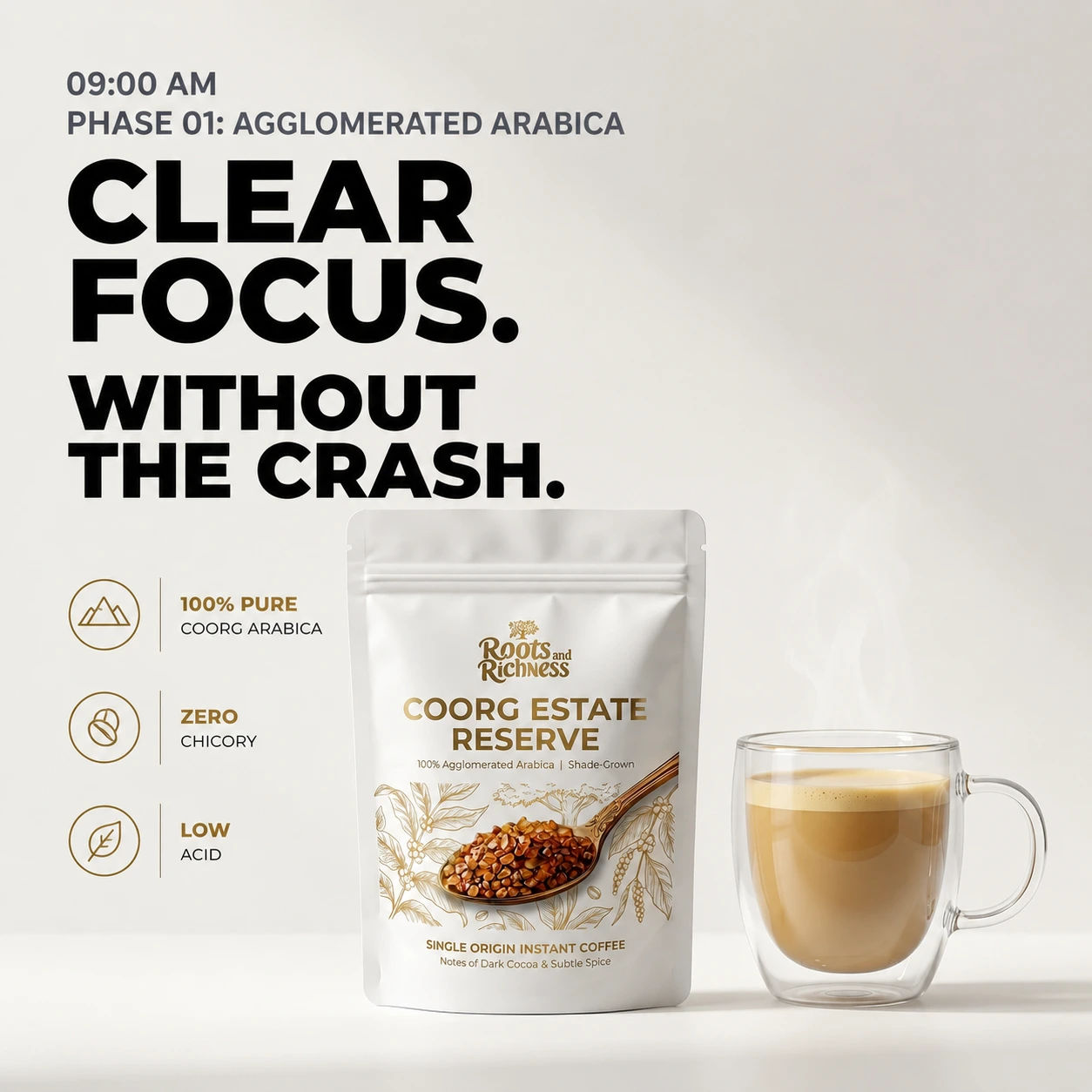
Low acidity, smooth on an empty stomach, gentle caffeine for a clear-headed start.
Shop AM ArabicaNeed an Afternoon Lift
PM · 100% Robusta
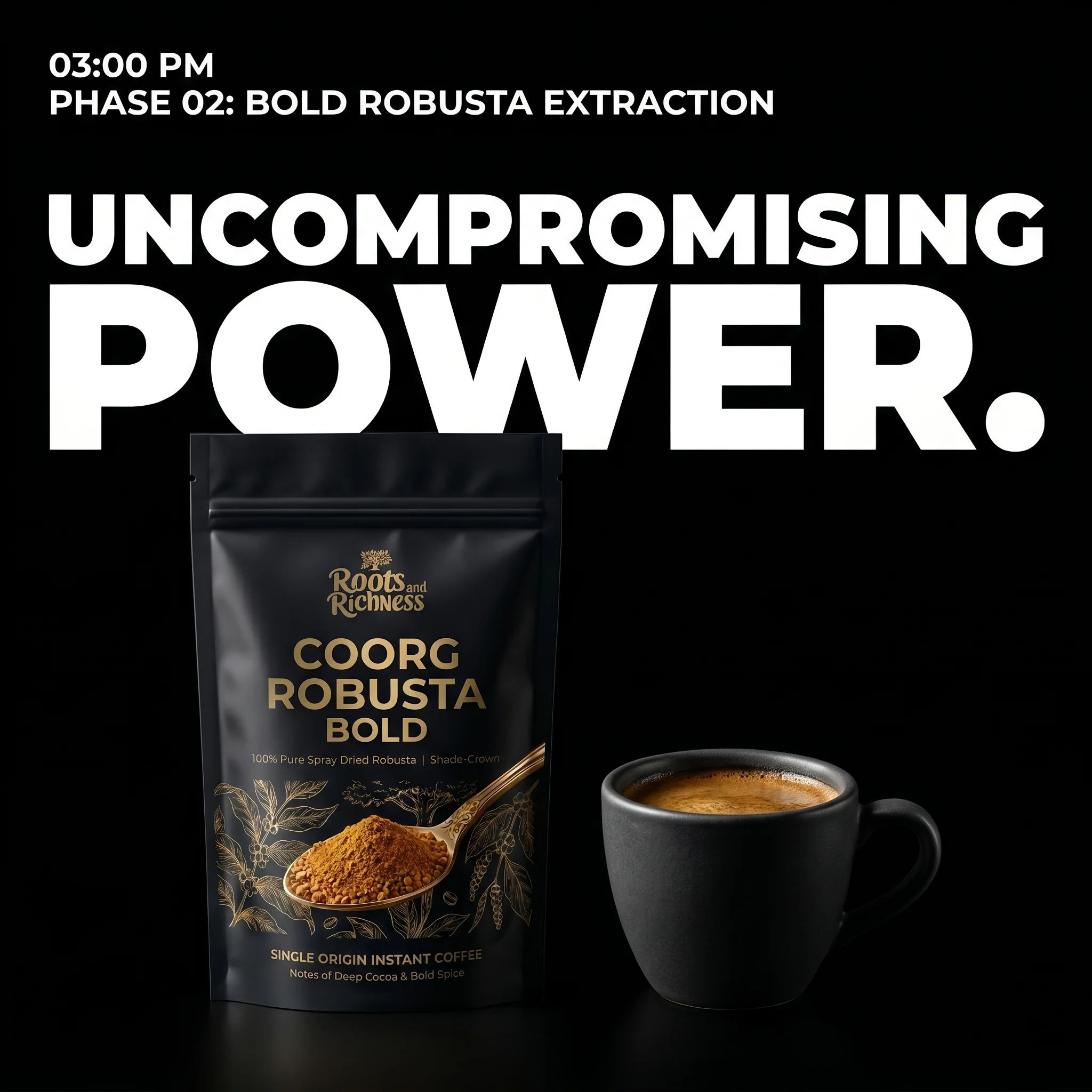
Nearly double the caffeine of Arabica — built for the 2–5 PM slump, clears before bed.
Shop PM RobustaCan't decide? Get both in the AM/PM Protocol →
Verifiably Chicory-Free
One Ingredient. Check the Label Yourself.
Both AM/PM Protocol pouches list "coffee" as the only ingredient — sourced from Coorg estates, nothing to dilute it.
A few things people usually ask before switching.
Frequently Asked Questions
What actually changes when you switch to chicory-free coffee?
Switching to chicory-free coffee increases the actual caffeine per cup, removes the flat and earthy aftertaste chicory adds, and means the full price you pay goes toward coffee rather than a cheaper filler root.
Is chicory-free coffee worth the higher price?
Chicory-free coffee is worth the price when it's verifiably 100% coffee, since you're paying for more actual coffee and more caffeine per serving than a chicory-blended tin at a similar price point.
Does chicory-free coffee taste stronger?
Chicory-free coffee tends to taste smoother and more aromatic rather than harshly stronger — much of the bitterness people associate with strong coffee actually comes from chicory, not the coffee bean itself.
Is it safe to drink chicory-free coffee every day?
Yes, for most healthy adults in normal amounts, following the same general caffeine guidance (roughly 3-4 cups or 400mg a day) that applies to any coffee, chicory-blended or not.
Is the AM/PM Protocol genuinely chicory-free?
Yes. Both the Arabica (AM) and Robusta (PM) pouches list coffee as the only ingredient, sourced from Coorg estates with no chicory, fillers, or anti-caking agents.
Featured Products Mentioned in This Article
Experience the premium wood-pressed oils we discussed in this article. Each product is traditionally processed and sourced directly from farmers.