Why Does Indian Instant Coffee Taste Bitter? (It's the Chicory)
Quick Answer
That earthy, bitter aftertaste in your instant coffee probably isn't the coffee at all. Most Indian brands blend in chicory root to stretch costs — here's how to check your label and what changes when you don't.
Key Takeaways
- Chicory is a roasted root vegetable, not coffee — it has zero caffeine.
- Indian labeling law requires ingredients in descending order, so "coffee, chicory" on a pack means it's a blend.
- That flat, earthy aftertaste in most instant coffee comes from chicory, not the bean.
- Pure coffee delivers more actual caffeine per serving than a chicory-diluted tin at the same price.
Chicory Blend vs. 100% Pure Coffee
| Attribute | Chicory Blend | 100% Pure Coffee |
|---|---|---|
| Caffeine per cup | Lower — diluted by filler | Full strength |
| Ingredient list | Coffee + chicory + fillers | Coffee. That's it. |
| Aftertaste | Flat, earthy, bitter | Clean, aromatic |
| Why it's cheaper to make | Chicory costs a fraction of coffee | N/A — no filler to cut cost with |
Quick Answers
What is chicory in coffee? Chicory is a roasted root vegetable added to coffee as a low-cost extender. It has no caffeine and is commonly blended into Indian instant coffee to reduce the amount of actual coffee needed per pack.
Is chicory bad for you? Chicory itself is not unsafe to consume. But chicory-blended coffee contains less actual coffee — and less caffeine — per serving than 100% pure coffee, often at a similar price point.
Why does Indian instant coffee taste bitter or earthy? That flat, woody aftertaste usually comes from chicory, not the coffee bean. Chicory roasts darker and more bitter than coffee, and it dilutes the aroma compounds that give coffee its richness.
How do I know if my instant coffee has chicory? Check the ingredients list. Under Indian food labeling rules, ingredients must be listed in descending order by quantity. If you see "coffee" followed by "chicory" or "roasted chicory," it's a blend. If it lists only "coffee," it's 100% pure.
Which Indian instant coffee brands don't contain chicory? Look for a label reading "100% pure coffee," "no chicory," or "single-origin." The AM/PM Protocol from Roots & Richness is one such option — both its Arabica and Robusta pouches list coffee as the sole ingredient.
Do Indian instant coffee brands contain chicory? Several Indian instant brand variants list chicory as an ingredient — check the specific SKU, since formulations differ across their product lines.
Chicory vs. Pure Coffee — What's Actually in the Tin
| Typical Chicory-Blended Instant Coffee | 100% Pure Coffee (e.g. AM/PM Protocol) | |
|---|---|---|
| Ingredient list | Coffee, chicory (often 20–40% chicory by volume) | Coffee. That's it. |
| Caffeine per serving | Lower — chicory has zero caffeine but takes up space in the blend | Full-strength — nothing diluting the coffee |
| Flavor profile | Flatter, earthier, more bitter aftertaste | Full aroma, cleaner finish |
| Why it's used | Chicory is cheaper than coffee beans, so blending cuts input cost | No cost-cutting substitution — priced on the coffee alone |
| How to verify | Read the ingredients list — chicory must be declared by law | Ingredients list reads "coffee" only |
Chicory percentages vary by brand and batch; check your specific product's label for the exact ratio, which manufacturers are required to disclose.
The Full Story
If you've ever wondered why your morning instant coffee has a slightly earthy, almost woody aftertaste that doesn't quite taste like coffee — you're not imagining it. It's chicory.
What is chicory, exactly?
Chicory is a root vegetable, related to endive, that's roasted and ground into a powder. Roasted chicory turns dark and bitter, and it's been used since the 1800s as a coffee extender in places where beans were expensive or scarce. It has no caffeine of its own — it's added for bulk and a coffee-adjacent color and bitterness, not for any effect.
Why is chicory in Indian instant coffee?
Cost. Chicory root costs a fraction of what coffee beans cost. Blending it in lets a brand stretch fewer coffee beans across more tins without raising the shelf price. This became so normalized in India that it's simply expected — most major instant coffee brands list chicory as the second ingredient, right after coffee. Most people have just never checked the label to see it.
How to tell if your coffee has chicory
Flip the tin or pouch. India's packaged food labeling rules require ingredients to be listed in descending order of quantity — so if you see "coffee" followed by "chicory" or "roasted chicory," you're drinking a blend. If the label reads only "coffee," it's pure.
Is chicory bad for you?
Not inherently — it's a real food ingredient, and some people even drink pure chicory as a caffeine-free coffee substitute on its own. The issue isn't safety, it's substitution: you're often paying coffee prices for a product that's only part coffee, and getting a flatter, more bitter cup for it. Since chicory has zero caffeine, a chicory-blended tin also delivers less actual caffeine per spoon than a 100% coffee tin — even though the spoon looks the same size.
What changes when you switch to 100% pure coffee
Once chicory is out of the picture, two things happen: the aftertaste that you'd gotten used to — the earthy, slightly bitter edge — disappears, and the caffeine per cup goes up, because every gram in the tin is coffee, not filler. This is also why bean origin starts to matter more once chicory is removed: with nothing to mask the flavor, differences between an Arabica and a Robusta bean actually come through, which is part of why pairing the right bean to the right time of day makes a bigger difference than most people expect.
Chicory-free instant coffee, done differently: the AM/PM Protocol
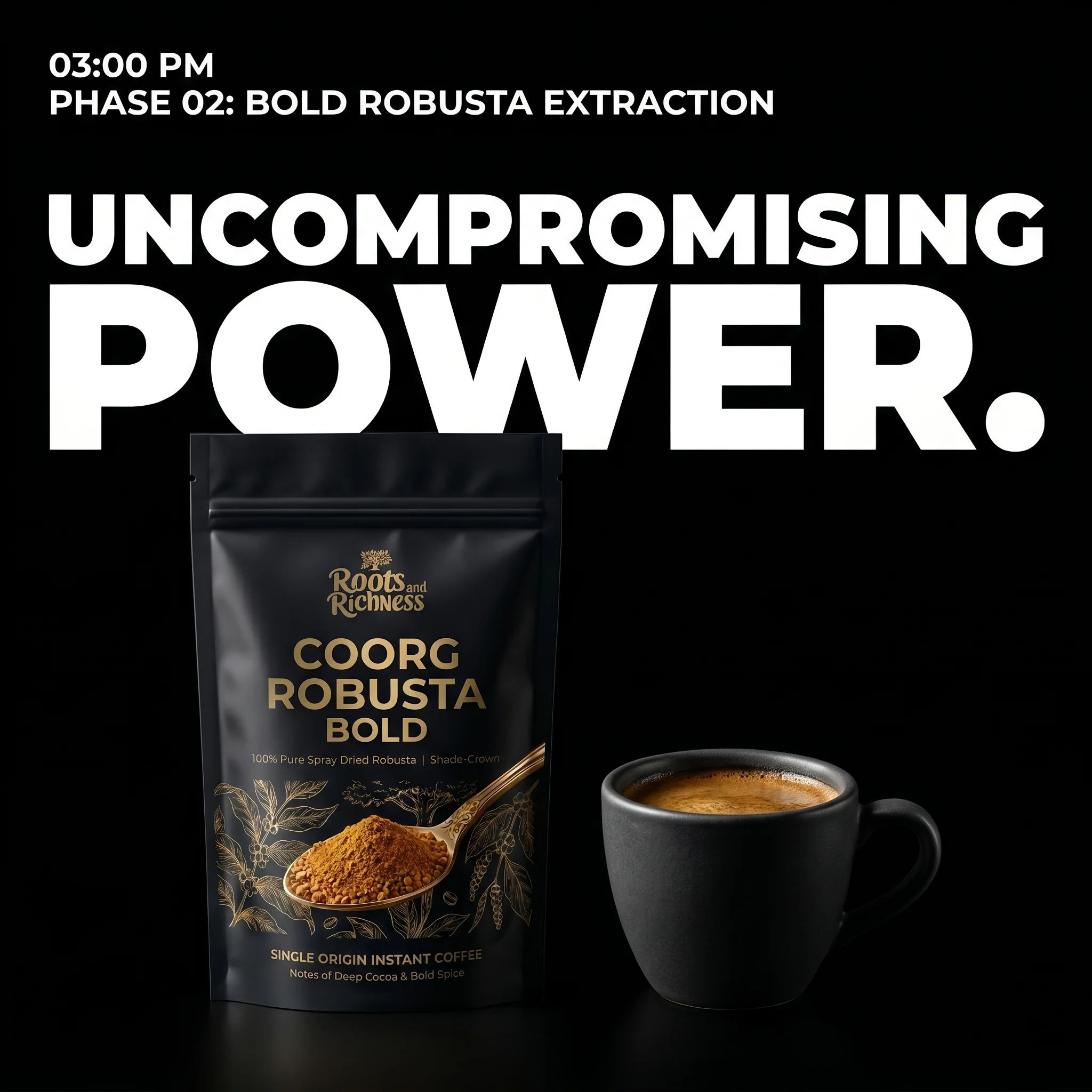
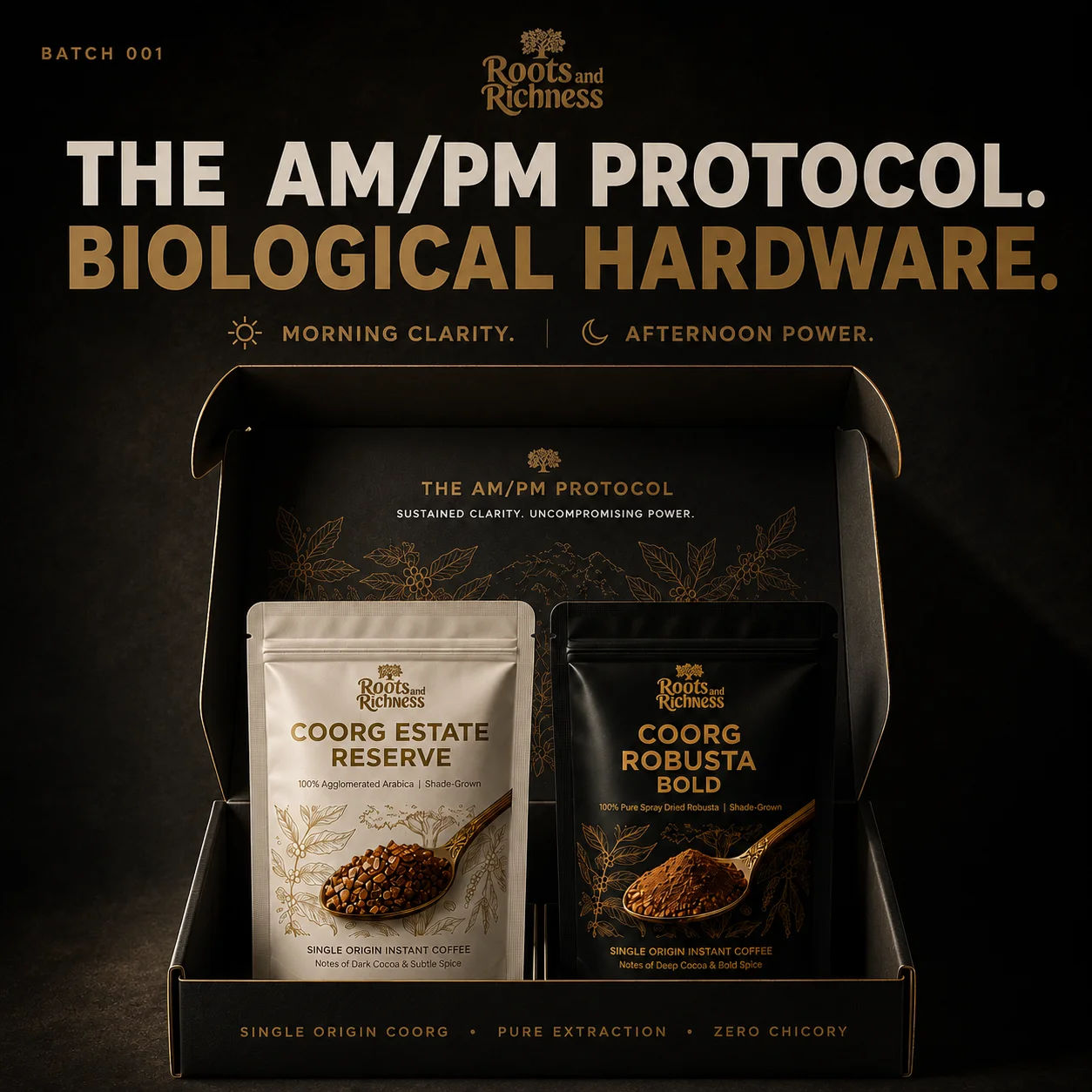
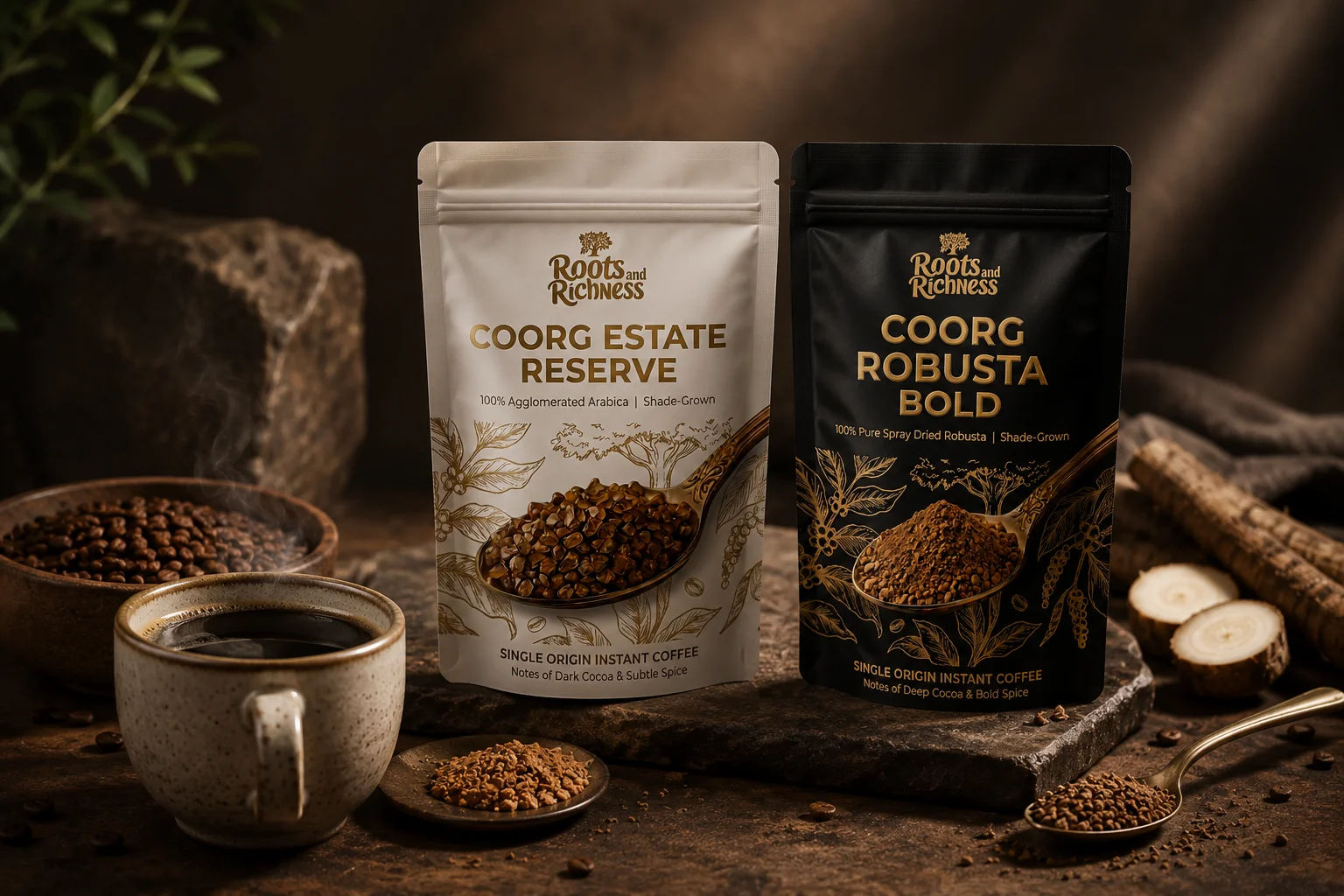
Roots & Richness built the AM/PM Protocol around exactly this gap. It's two 100g pouches — a single-origin Coorg Arabica for the morning, a single-origin Coorg Robusta for the afternoon — both with an ingredients list that reads only "coffee." No chicory, no fillers, no anti-caking agents. It's sourced directly from Coorg estates and packed in Karnataka, so there's no blending step where a cheaper filler could get introduced.
At ₹799 for 50 cups, that works out to ₹16 a cup — less than a tenth of what a café charges, and priced in the same range as the chicory-blended tins on the shelf next to it, minus the chicory.
93 of 100 units in this batch are already gone. It's roasted and packed in small batches out of Coorg, so once this run sells out, the next isn't ready for 3–4 weeks.
Frequently Asked Questions
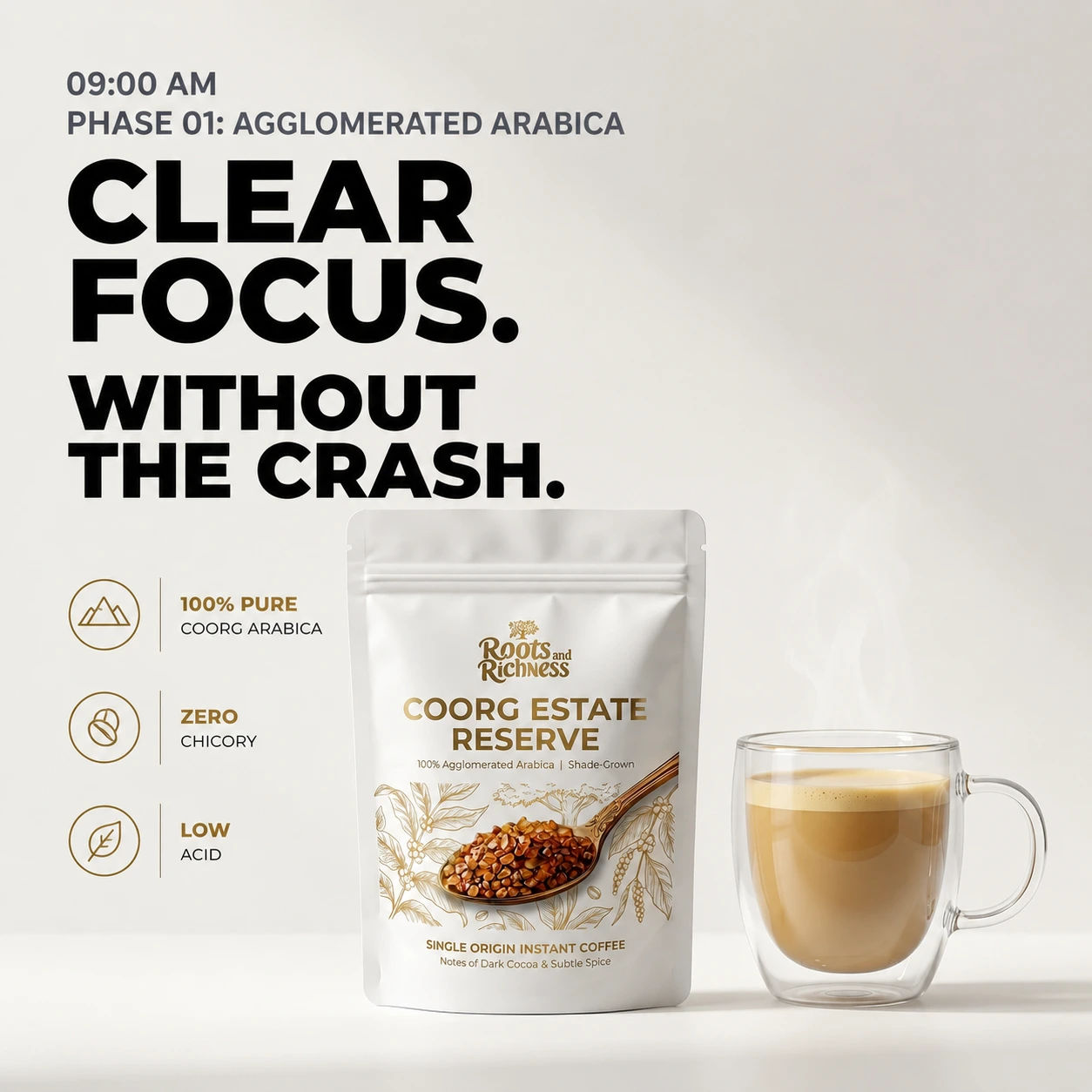
Does the AM/PM Protocol contain chicory? No. Both the Arabica (AM) and Robusta (PM) pouches list coffee as the only ingredient — no chicory, no fillers, no anti-caking agents.
Will switching from a chicory blend to pure coffee taste too strong? It'll taste different, not necessarily stronger in a harsh way — the bitterness most people associate with "strong" coffee often comes from chicory, not the coffee itself. Pure coffee tends to taste smoother and more aromatic, especially with a lower-acid Arabica in the morning.
Is single-origin coffee worth paying more for if I'm used to blended brands? Since single-origin, chicory-free coffee has no filler diluting it, you're getting more actual coffee — and more caffeine — per serving than a blended tin at a similar price, which is part of what you're paying for.
How do I switch from a chicory brand without disliking the change? Start with the AM pouch (Arabica) black or with a little milk — it's lower in acidity and smoother than most people expect from "pure" coffee. The flavor difference is usually a pleasant surprise rather than a jarring one.
Ready to taste the difference? Get the AM/PM Protocol — ₹799 for 50 cups · Free shipping · 7-day refund guarantee · 7 units left in this batch
Did You Know?
Chicory root was originally used as a coffee substitute during shortages — it was never meant to be a permanent additive.
Did You Know?
Some of India's best-known instant coffee brands blend 20–40% chicory into every tin, even at premium price points.
Still Deciding?
Which Coffee Is Right for You?
Morning Person
AM · 100% Arabica
Low acidity, smooth on an empty stomach, gentle caffeine for a clear-headed start.
Shop AM ArabicaNeed an Afternoon Lift
PM · 100% Robusta
Nearly double the caffeine of Arabica — built for the 2–5 PM slump, clears before bed.
Shop PM RobustaCan't decide? Get both in the AM/PM Protocol →
Zero Chicory, Verified
Curious What 100% Pure Coffee Actually Tastes Like?
The AM/PM Protocol contains exactly one ingredient — coffee. No chicory, no fillers, nothing to explain away the bitterness.
A few things people usually ask before switching.
Frequently Asked Questions
What is chicory in coffee?
Chicory is a roasted root vegetable added to coffee as a low-cost extender. It has no caffeine and is commonly blended into Indian instant coffee to reduce the amount of actual coffee needed per pack.
Is chicory bad for you?
Chicory itself is not unsafe to consume. But chicory-blended coffee contains less actual coffee and less caffeine per serving than 100% pure coffee, often at a similar price point.
Why does Indian instant coffee taste bitter or earthy?
That flat, woody aftertaste usually comes from chicory, not the coffee bean. Chicory roasts darker and more bitter than coffee, and it dilutes the aroma compounds that give coffee its richness.
How do I know if my instant coffee has chicory?
Check the ingredients list. Under Indian food labeling rules, ingredients must be listed in descending order by quantity. If you see 'coffee' followed by 'chicory' or 'roasted chicory,' it's a blend. If it lists only 'coffee,' it's 100% pure.
Does the AM/PM Protocol contain chicory?
No. Both the Arabica (AM) and Robusta (PM) pouches list coffee as the only ingredient — no chicory, no fillers, no anti-caking agents.
Will switching from a chicory blend to pure coffee taste too strong?
It will taste different, not necessarily stronger in a harsh way. The bitterness many people associate with 'strong' coffee often comes from chicory rather than the coffee itself, so pure coffee tends to taste smoother and more aromatic.
Is single-origin coffee worth paying more for if I'm used to blended brands?
Since single-origin, chicory-free coffee has no filler diluting it, it delivers more actual coffee and more caffeine per serving than a blended tin at a similar price point.
Featured Products Mentioned in This Article
Experience the premium wood-pressed oils we discussed in this article. Each product is traditionally processed and sourced directly from farmers.